Press release —
“Innovation is born from exchange” >>> New ‘Living Farm’ podcast series from the Section for Agriculture at the Goetheanum
Goetheanum, Dornach, Switzerland, 11 June 2026
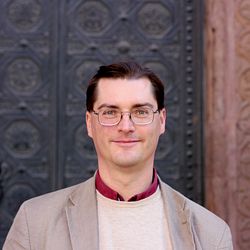
In his monthly podcast ‘Living Farms’, Eduardo Rincón, co-leader of the Section for Agriculture, talks to international guests, discussing with them existing paradigms and considering new ways of developing farming so that it serves life in all its manifestations.
The dying of trees and large-scale deforestation paint a sombre picture of the state of our forests. Brazilian agronomist Natalia Muguet, Rincon’s guest on the first episode of the new series of the ‘Living Farms’ podcast, which is entitled ‘Biodynamics and Holistic Agroecology‘, works against this trend by regenerating degraded landscapes and creating productive, diverse and stable systems. She works with multi-layered plantation, targeted pruning and building up of biomass to direct energy flows and actively improve soil fertility.
Soil is continuously built up through targeted pruning and by leaving organic matter in the system. Rather than exhaust resources, self-nurturing cycles are created that increase productivity in the long term. Medicinal and crop plants have a special part to play in this process. Medicinal plants promote soil life, stabilize ecological processes and contribute to the regeneration of damaged fields. This means that plants are not only viewed as profit factors but as active co-creators of a living system.
Eduardo Rincón sees “crucial future potential in combining biodynamic farming with other holistic approaches such as permaculture, organic or syntropic agriculture.” He is convinced that “innovation is born precisely from exchange, joint research, practical experiments and interdisciplinary collaboration. Different views of soil, plants, eco-systems and people enable the finding of new answers to the pressing challenges of our time, from climate change and the loss of biodiversity to economic pressures.” In the second episode of the new series, vegetable farmer Tom Saat from Stadsboerderij in Almere, Netherlands, shows how biodynamic farming methods can transform regional changes into opportunities.
The series on ‘Biodynamics and Holistic Agroecology’ is aimed at experts and anyone interested in holistic agroecology and sustainable food systems. Anyone seeking to engage more deeply with such questions is welcome to register with the Biodynamic Network to discuss and explore them further.
(2315 characters, 339 words/Sebastian Jüngel; English by Margot M. Saar)
Biodynamic Network for members of the biodynamic movement
Contact person Anna Storchenegger
Topics
Categories
The Goetheanum is the headquarters for the School of Spiritual Science and the General Anthroposophical Society. The School of Spiritual Science with its eleven sections is active worldwide in research, development, teaching, and the practical implementation of its research findings and is supported by the Anthroposophical Society.